
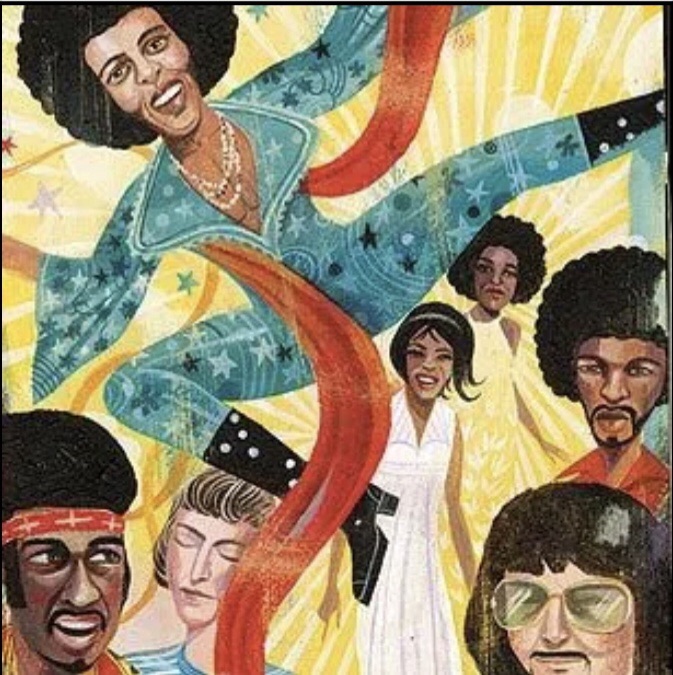
By Don Was, A musician, record producer (close to 100M albums), music director, film composer, documentary filmmaker and radio host. In recent years, is president of Blue Note Records (since 2011) and toured as bassist for Bob Weir and The Wolf Bros (since 2018). Produced records for a wide range of artists including: The Rolling Stones, Bob Dylan, Willie Nelson, John Mayer, Wayne Shorter, Kris Kristofferson, Iggy Pop, The B 52s, Brian Wilson, Elton John, Garth Brooks, Ryan Adams and Bonnie Raitt (whos “Nick of Time” album in 1989 won the album of the year). Illustrator: Olaf Hajek.
Sly and The Family Stone didn’t have to say, “Why can’t we all just get along?” Looking at the band members and listening to their shared sound made the statement. On the early Sly and the Family Stone records, there was just no acknowledgment of race; they’re truly utopian. A real idealism comes across loud and clear on songs like “Everyday People” and “Hot Fun in the Summertime,” and people need messages like that. The band had blacks and whites, men and women. Seeing this group that embraced so many elements of society sort of drew you in as an extended family member. This was a joyous noise and a joyful vision. Sly was monumental in his contribution to music.
Sly and The Family Stone’s greatest hits playlist:
https://open.spotify.com/playlist/1zt0DU3WTrrZkvVQP1BTui?si=ultOz-CcTeagUUbpF-4vIQ&pi=mSIQvIhwRCO0o
On musical terms, the Family Stone were an amazing band, but there was no doubt Sly Stone was the leader. He is a singular funk orchestrator; Duke Ellington is probably the best reference point. No one had taken elements of funk and combined them the way Sly did. Sly orchestrated those early records in very advanced ways — a little guitar thing here that would trigger the next part that would trigger the next part. Then, as time went on, Sly started using some more dissonant colors; he became like the Cézanne of funk. It’s like he took these traditional James Brown groove elements and started putting orange into the picture.
Somewhere along the way, around the time of There’s a Riot Goin’ On, Sly got disillusioned. I think he discovered that the utopian worldview worked in his band, but when he got out in everybody else’s world, he still couldn’t walk into a bar in Mobile, Alabama, without getting into a fight. That will change you. Freshis from a guy who realizes that nobody — not Sly Stone, not the Rothschilds — nobody can mess with the forces of history. Que será será.
Fresh is a very deep piece of work. It’s the sound of a guy who has hit the pinnacle and is free-falling. Why is Sly singing “Que Sera Sera” on the album? Because he’s got no f_____g control. When the magic hits, it’s a gift that can go away just as quickly as it came.
Without Sly, the world would be very different. Every R&B thing that came after him was influenced by this guy.
The so-called revolution that was coming at the end of the Sixties: We might have lost that one, but Sly won his own personal revolution, musically and in the minds of the audience. I just hope he knows that, I hope he’s not sitting around with any kind of remorse. Because by any real criteria that you measure success, this guy is a titan.
 All-Time Greatest Music